
October is Breast Cancer Awareness Month, a time when we are reminded of the importance of checking our breasts, attending our mammograms and being proactive about our breast health. But there is one important aspect of breast health that many women have never even heard of.
Breast density.
Do you know yours? Have you ever been told what it is? More importantly, do you know why it matters? We spend plenty of time encouraging ourselves to know our blood pressure, cholesterol, blood glucose and so on. At this stage, most of us could nearly do with a spreadsheet just to keep track of ourselves! Breast density is another important piece of our health information, and it's one that deserves far more attention.
I recently received a powerful piece written by Laurna Quirke, a breast density advocate involved in the national #TellMeMyBreastDensity campaign. Laurna's personal experience highlights why awareness matters and why campaigners are calling for all women in Ireland to be informed of their breast density alongside their mammogram results.

What is breast density?
Breasts are made up of a combination of fatty tissue, glandular tissue and fibrous connective tissue. Breast density refers to the proportion of glandular and fibrous tissue compared with fatty tissue. Women who have a higher proportion of glandular and fibrous tissue are described as having dense breasts.
Interestingly, around half of women undergoing mammography have dense breast tissue, although density varies with age and other factors. Breast density has nothing to do with whether you're an A cup or an FF, your body weight or how firm your breasts feel. It is a radiological finding, identified through a mammogram.
Why does breast density matter?
There are two important reasons every woman should understand breast density. Firstly, having dense breast tissue is associated with an increased risk of developing breast cancer. Secondly, dense tissue can make it more difficult for radiologists to identify cancer on a mammogram.
Let's look at that second point. On a mammogram, fatty breast tissue appears darker, while dense tissue appears white. Unfortunately, many breast cancers also appear white. This means that identifying a cancer in particularly dense breasts can be like trying to find a snowflake in a snowstorm.
Mammograms remain an incredibly important screening tool and save lives. However, like all screening methods, they have limitations. Having a clear mammogram is reassuring, but it cannot guarantee that cancer is not present. This is particularly important for women with dense breast tissue.
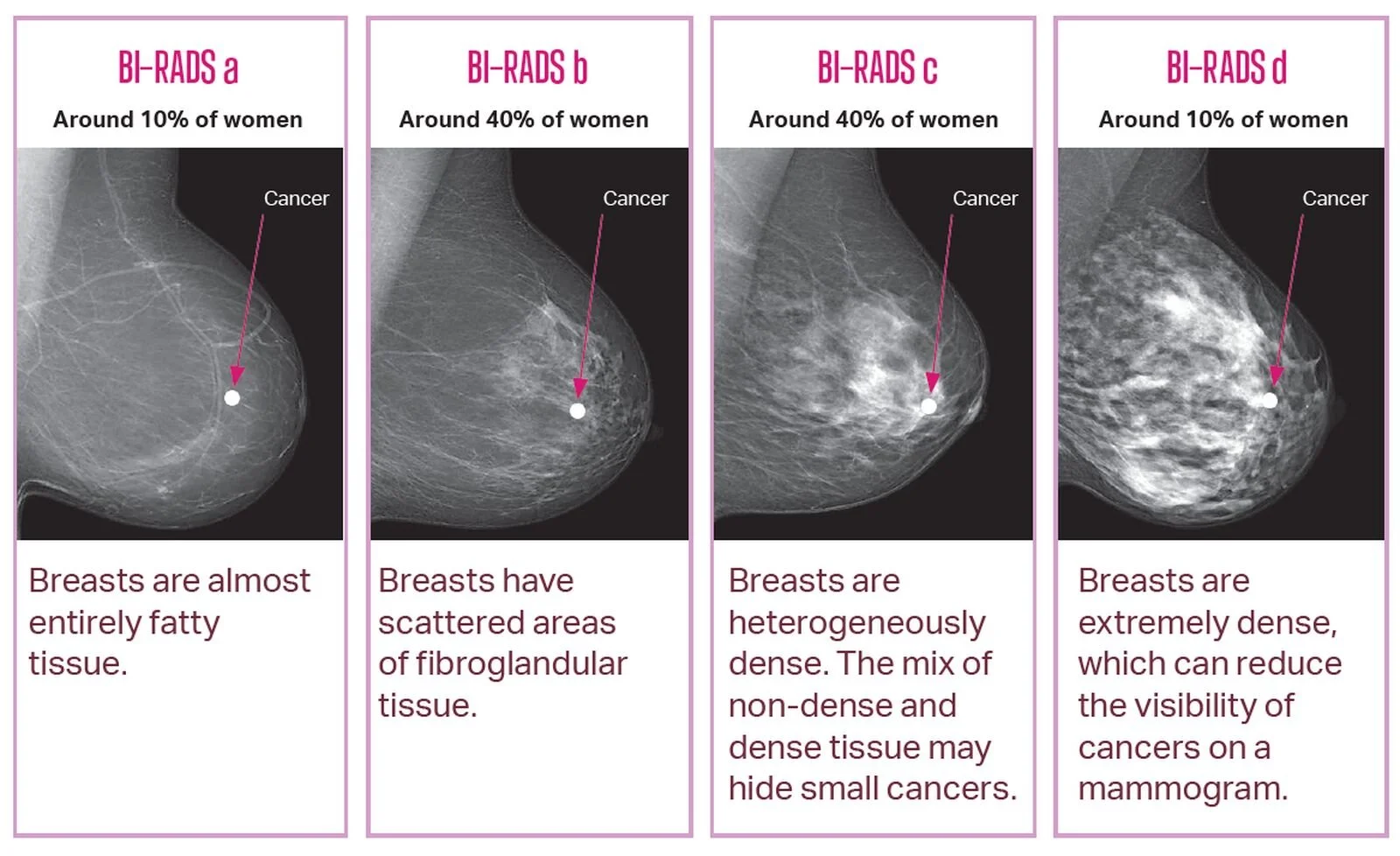
The four categories of breast density explained
Breast density is classified using the Breast Imaging Reporting and Data System (BI-RADS), which has four categories. The graphic above illustrates how the appearance of breast tissue changes across the four categories and how increasingly dense tissue can make cancers harder to distinguish.
Category A – Almost entirely fatty
Approximately 10% of women fall into this category. The breasts contain predominantly fatty tissue, which appears darker on a mammogram, making many abnormalities easier to identify.
Category B – Scattered areas of fibroglandular density
Approximately 40% of women fall into this category. There are scattered areas of dense tissue, but much of the breast remains fatty.
Category C – Heterogeneously dense
Approximately 40% of women fall into this category. There is a significant amount of dense breast tissue, which can obscure small cancers on a mammogram.
Category D – Extremely dense
Approximately 10% of women fall into this category. The breast contains very high levels of dense tissue, making it considerably more difficult to identify some cancers through standard mammography. Categories C and D are classified as dense breasts.
Now, take another look at the graphic. Notice how clearly the small white cancer is visible in image A compared with image D? As you move across the images, the surrounding breast tissue becomes increasingly white, making the cancer more difficult to distinguish.
Does having dense breasts increase your cancer risk?
Yes. Breast density is an established, independent risk factor for developing breast cancer. Research has shown that women with extremely dense breasts can have four to six times the risk of developing breast cancer compared with women who have almost entirely fatty breasts.
Importantly, this comparison relates to the two extremes of breast density. It does not mean that every woman with dense breasts has a four-to-sixfold increase in risk. It also doesn’t mean that having dense breasts means that you will develop breast cancer. Most women with dense breasts won’t.
However, density is an important factor when assessing someone’s overall breast cancer risk. Other factors, including age, family history, genetic risk, previous breast conditions and lifestyle, must also be considered. Tis is why knowing your breast density matters. It provides another piece of information that can help you and your healthcare professional make informed decisions about your breast health.
Laurna Quirke's story: Why she is campaigning for change
Behind the #TellMeMyBreastDensity campaign are real women whose lives have been profoundly affected by breast cancer. One of those women is Laurna Quirke.
In 2020, aged just 38, Laurna was referred by her GP for a mammogram. She was told the result was clear. In 2024, she was referred for another mammogram. Again, she received a clear result. In June 2025, Laurna was referred by her GP for a third mammogram. Two weeks later, in July 2025, following a biopsy, she was diagnosed with invasive lobular breast cancer.
Her subsequent pathology confirmed Stage 3 breast cancer, with a tumour measuring 12 cm x 8 cm. In September 2025, Laurna underwent a double mastectomy and axillary clearance. Her treatment has included five months of chemotherapy and 15 sessions of radiotherapy. She also has reconstructive surgery planned for 2027. In addition, Laurna has commenced a seven-year endocrine therapy plan, which has induced menopause.
As many women will understand, menopause can bring significant physical and emotional challenges. When menopause is induced by cancer treatment, those challenges can be particularly complex, especially while navigating the impact of surgery, chemotherapy, radiotherapy and recovery. Laurna describes how these medical terms have become part of her everyday language, despite the reality that the treatments themselves are anything but ordinary.
What particularly struck me about Laurna's story was her explanation that, had she known about her dense breast tissue and understood its significance, she would at least have had the opportunity to ask questions and advocate for herself. Of course, we cannot know whether earlier notification would have changed her individual diagnosis or outcome.
But we deserve access to relevant information about our own bodies. We cannot expect ourselves to advocate for our health when we don't know what questions we should be asking.
What is invasive lobular breast cancer?
Invasive lobular carcinoma (ILC) is the second most common type of invasive breast cancer, after invasive ductal carcinoma. It begins in the milk-producing glands, known as lobules, and spreads into surrounding breast tissue. Lobular breast cancer accounts for approximately 10–15% of invasive breast cancer diagnoses.
One of the challenges associated with lobular breast cancer is that it can grow in a less distinct pattern than some other breast cancers, making it more difficult to detect through conventional imaging. Dense breast tissue can add another layer of difficulty. This makes awareness of both breast density and the limitations of mammography particularly relevant.
The #TellMeMyBreastDensity national campaign
On 13 October 2026, women from across Ireland, including representatives of Lobular Ireland, met TDs and Senators at Leinster House. They shared their personal experiences of breast cancer and the importance of breast density awareness.
The national #TellMeMyBreastDensity campaign has a very simple request: Every woman should be informed of her breast density alongside her mammogram results.
Currently, routine breast density notification is not part of Ireland's BreastCheck screening pathway. Campaigners believe women should be given this information so they can better understand their individual risk, discuss screening options with healthcare professionals and make informed decisions.
The campaign is not calling for women to stop attending mammograms. Quite the opposite. It is about ensuring women receive a full picture of their breast health. Laurna and her fellow advocates believe we should not have to wait until after a breast cancer diagnosis to discover that we have dense breasts.
What is happening in Ireland?
BreastCheck is Ireland's national breast screening programme, which currently offers eligible women aged 50–69 a free mammogram every two years.
In March 2026, the Health Information and Quality Authority (HIQA) announced that it had commenced a Health Technology Assessment examining the potential inclusion of breast density within the BreastCheck screening pathway.
The assessment, requested by the National Screening Advisory Committee, is considering several important questions, including:
Whether breast density should be routinely measured and reported.
Whether women should be notified of their breast density.
Whether screening pathways should be adapted for women with dense breast tissue.
The potential benefits, risks and wider implications of introducing these changes.
This is welcome progress. However, Laurna and other campaigners are concerned about how long it may take for any recommendations to translate into changes in clinical practice. Their message is that women need information about their breast density now.

Should women with dense breasts have additional screening?
This is an important question, and the answer depends on individual circumstances.
A mammogram remains an effective tool for breast cancer screening. However, additional imaging may be appropriate for some women, particularly those with extremely dense breast tissue or other risk factors.
Depending on individual risk and clinical circumstances, additional imaging options may include breast ultrasound, MRI or other specialised breast imaging techniques.
The European Society of Breast Imaging (EUSOBI) recommends that women with extremely dense breasts are offered supplemental MRI screening, based on evidence demonstrating improved cancer detection in this group.
This does not mean that every woman with dense breasts automatically needs an MRI. Additional screening can also have potential disadvantages, including false-positive findings, further investigations and unnecessary biopsies.
The most appropriate approach should always be considered through an individual assessment and discussion with a healthcare professional. That brings us back to the importance of knowing your breast density in the first place. How can women participate fully in discussions about their screening options if they haven't been given this information?
What can you do to protect your breast health?
While the campaign continues to push for changes at national level, there are practical steps every woman can take.
1. Ask about your breast density
If you have previously had a mammogram, ask whether your breast density was assessed and whether this information is available. It may not be routinely included in your screening results, but asking the question is a good starting point.
2. Understand your individual risk
If you are told you have dense breasts, discuss what this means with your GP or breast specialist. Breast density is one part of the picture, and your overall risk should take other relevant factors into account.
3. Discuss whether additional screening is appropriate
If you have particularly dense breasts, ask whether further imaging or an individualised screening approach would be beneficial. Not every woman will need additional screening, but knowing your options allows you to participate in the decision.
4. Continue attending mammograms
Please don't let this conversation discourage you from attending BreastCheck. Mammograms remain an important part of early breast cancer detection. If you are aged 50–69 and receive an invitation to BreastCheck, take it up.
5. Know what's normal for your breasts
This is something every woman should be familiar with, regardless of age or breast density. Be aware of changes such as:
A new lump or thickening in the breast or armpit.
Changes in breast size or shape.
Skin changes, including dimpling or puckering.
Nipple changes or unusual discharge.
Persistent, unexplained changes or discomfort.
If something feels unusual or different, please have it checked by your GP. And importantly, don't wait for your next screening invitation if you notice a change. A previous clear mammogram does not mean that a new or persistent symptom should be ignored.
Working in women's health, one message I continually come back to is the importance of understanding our bodies. We talk about knowing our blood pressure, cholesterol, blood glucose and bone health. We encourage women to become more proactive about their health, particularly through midlife and menopause.
Yet breast density remains something that many women have never been told about, despite its relevance to breast cancer risk and screening. This is why Laurna Quirke's advocacy and the #TellMeMyBreastDensity campaign are so important.
It isn't about creating unnecessary worry or suggesting that mammograms don't work. It's about giving us information that is relevant to their health so we can ask better questions, understand our options and participate in decisions about our care.
Laurna's campaign headline captures that message:
"Tell Me My Breast Density Before You Tell Me I Have Breast Cancer."
I would encourage you reading this to share it. Because sometimes the most important health information we can share is something another woman doesn't even know she needs to ask about.
A huge thank you to Laurna for sharing such a deeply personal experience and for turning that experience into advocacy for other women.

References and further reading
HIQA – Assessment of including breast density within the BreastCheck screening pathway (March 2026)
National Cancer Institute – Dense Breasts: Answers to Commonly Asked Questions
European Society of Breast Imaging – Recommendations for women with extremely dense breasts
Laurna Quirke – Personal account and advocacy statement, #TellMeMyBreastDensity campaign, October 2026.
Thanks to Laurna Quirke and Lobular Ireland for sharing this important story and helping to raise awareness of breast density in Ireland. This blog is intended for general education and awareness and should not replace individual medical advice.